Upon visiting a museum I am always asking "Of all the subjects why paint this? What influenced you? What was your life like, that you would feel the drive to create in this manner?" and on and on. Likewise, museums carry very limited collections. I don't believe one piece from a particular artist gives the viewer a clear vision of the artist's messages and meaning.
So, I find myself taking pictures so I can google more information; and I've had a very wonderful afternoon...So, lets' begin my art loving friends:
FAIRFIELD PORTER
Fairfield Porter was an American Painter and art critique. He took most of his subject matter from his surroundings, friends, and family in a representational style. His goal was to "make everything more beautiful".
Personally I am loving his choice of colors.
ILSE BING bought a Lecia in 1929, the new revolutionary 35mm hand-held camera that enabled photographers to capture fast-moving events. She was a self taught photographer who became extremely proficient in the use of this camera and was deemed "Queen of the Lecia" by a leading critic of the period. Her style? A bit of photo journalism and Avant-Garde.
Many years later she took this self portrait titled
"Still the Queen of Lecia”Now here's a fellow who's studio I'd like to see.
This Alabama sculptor creates works that appear both realistic and mythological. I couldn't find much on him, but I do like his work.
Below:
Hunter of the Pleasured Souls and Sacred Spirits. (Sounds like a movie eh?)
By clothing these figures, Fleming helps the viewer to relate to them and confront the dualities of the rational and the irrational sides of human nature. In this piece, Fleming connect the supernatural and the living world, creating a haunting beast that both attracts and repels.
AFRICAN ART
There were a lot of African artifacts as well. I don't necessarily like African art, but I do admire how extremely stylized, distorted, and personality ridden the pieces are.
Below: Mask of the Bewitched.
This Mhangu ("the bewitched") mask depicts a community member under attack by malevolent sorcery. The left side of the mask displays whited, regular features signifying health. The blackened, twisted features of its opposite side symbolizes illness and death as a result of the sorcere's spell at work on its victim. (The mask is worn during a ritualistic dance to illustrate a storyline.)
The photos come from a series called "The Pleasures and Terrors of Levitation, 1961.
Aaron worked for years as a social documentary photography but then turned to more abstract work in the 1940's. The title of this group suggested the contradictory feelings of exhilaration and fear. By his choice of a low vantage point, Siskind effectively removes the divers from the familiar real-world context. Instead he suggests that the figure is flying or falling through space that is as much psychological as physical.
I would actually love to see something like this enlarged (very large) to fill a whole wall.
Below: unknown art installation. Sorry. I dropped the ball on this one. But it was large and filled a very large wall in the museum. Very cool. Can't find a credit for it.
DIANE ARBUS
Probably one of the more famous artists on display. Had I recognized her name, I would have spent more time looking at her work.
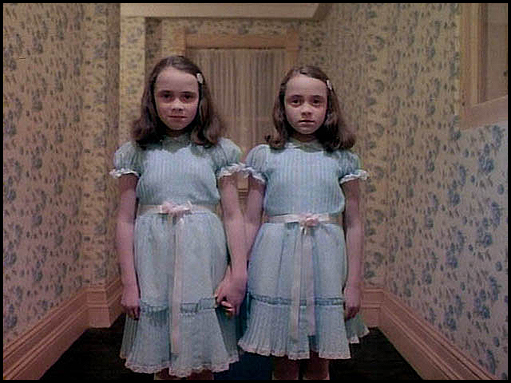
Yes, you
have seen this piece somewhere before...there is a scene in
The Shining which is a direct homage to Diane. Right down to one twin smiling and the other slightly frowning.
Diane Arbus was one of the most original and influential photographers of her era. She came from a privileged background but was drawn to odd or "forbidden" subjects, including nudists, transvestites, and circus performers, which she recorded in a direct, even confrontational manner. (Her camera —a square frame of the 2-1/4-inch held at waist level—allowed her to look her subjects in the eye.) Arbus was also fascinated by twins and triplets as part of larger interest to the public.

A few years ago I asked Adam to watch
"Fur, an imaginary portrait of Diane Arbus" with me, staring Nicole Kidman. It was odd
to say in the least and I didn't completely understand it, (and it's not the kind of movie you recommend to friends). But now, after reading up on Diane, and seeing more of her dark work I am compelled to say, the movie seemed at least to capture the essence of her mind. And I believe she thought a lot about her subjects and became involved in their tragedies—in a skewed way—but which probably allowed her work to speak so loudly.
Diane once stated about being photographer: T
here are certain evasions, certain nicenesses, that I think you have to get out of…the process itself has a kind of exactitude. A kind of scrutiny that normally we're not subject to, I mean that we don't subject others to. We're nicer to each other than the intervention of the camera is going to make us..."
Below: Double self portrait.
And that is it for today friends. Oh how I wish we could all take an art history class together so that we would get more out of our trips to the museum. Oh well. Oh well.